Reflecting on KEDC’s Work in 2025 and Looking Ahead to 2026

A Community Vision board created by Kodiak residents during an outreach event early summer 2025 at the Kodiak Marketplace.
From Planning to Action
In 2025, the Kodiak Economic Development Corporation focused on moving major community priorities from planning toward implementation. Much of this work happened behind the scenes, through coordination, listening, analysis, and partnership building. While not always visible day to day, this foundational work was essential to ensuring that future efforts are grounded, realistic, and shaped by the people who live and work across the Kodiak Archipelago.
As we move into 2026, KEDC’s work is becoming more tangible and outward facing. The systems, partnerships, and plans developed over the past year now provide a clear framework for action, accountability, and continued collaboration.
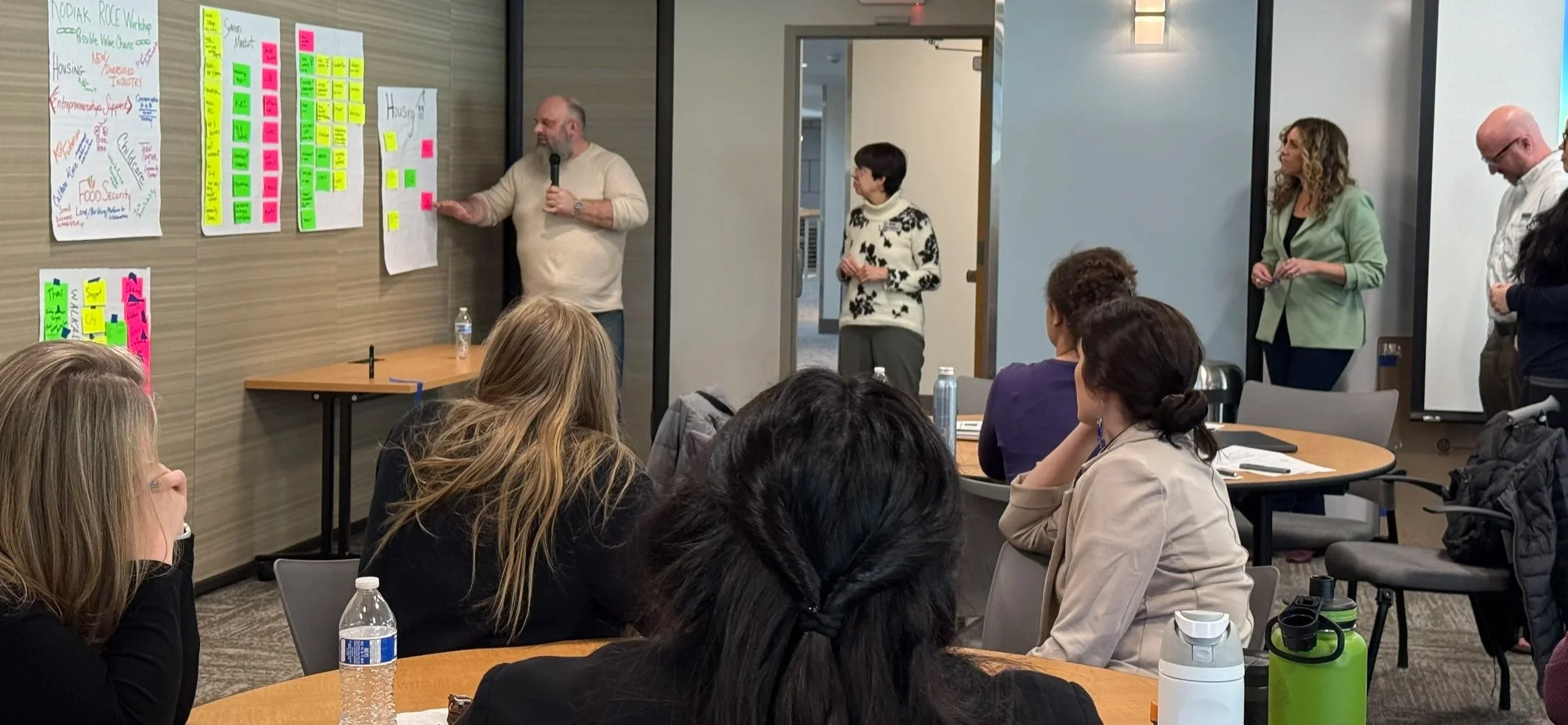
Community members advise and share needs and opportunities to strengthen Kodiak’s economic drivers.
KEDC’s role in Kodiak’s economy
KEDC exists to strengthen and diversify Kodiak’s economy through collaboration, innovation, workforce development, and sustainable practices that honor our island’s culture, people, and natural resources. Our role is not to duplicate services or replace the work of others. Instead, we convene partners, align resources, and help move shared priorities from idea to action.
Kodiak’s challenges are interconnected. Housing availability affects workforce retention. Workforce development affects business growth. Infrastructure readiness affects long term investment. Because of this, KEDC is intentional about how projects connect to one another and how efforts build toward shared outcomes.
That approach guided our work throughout 2025.
Advancing housing work through coordination and transparency
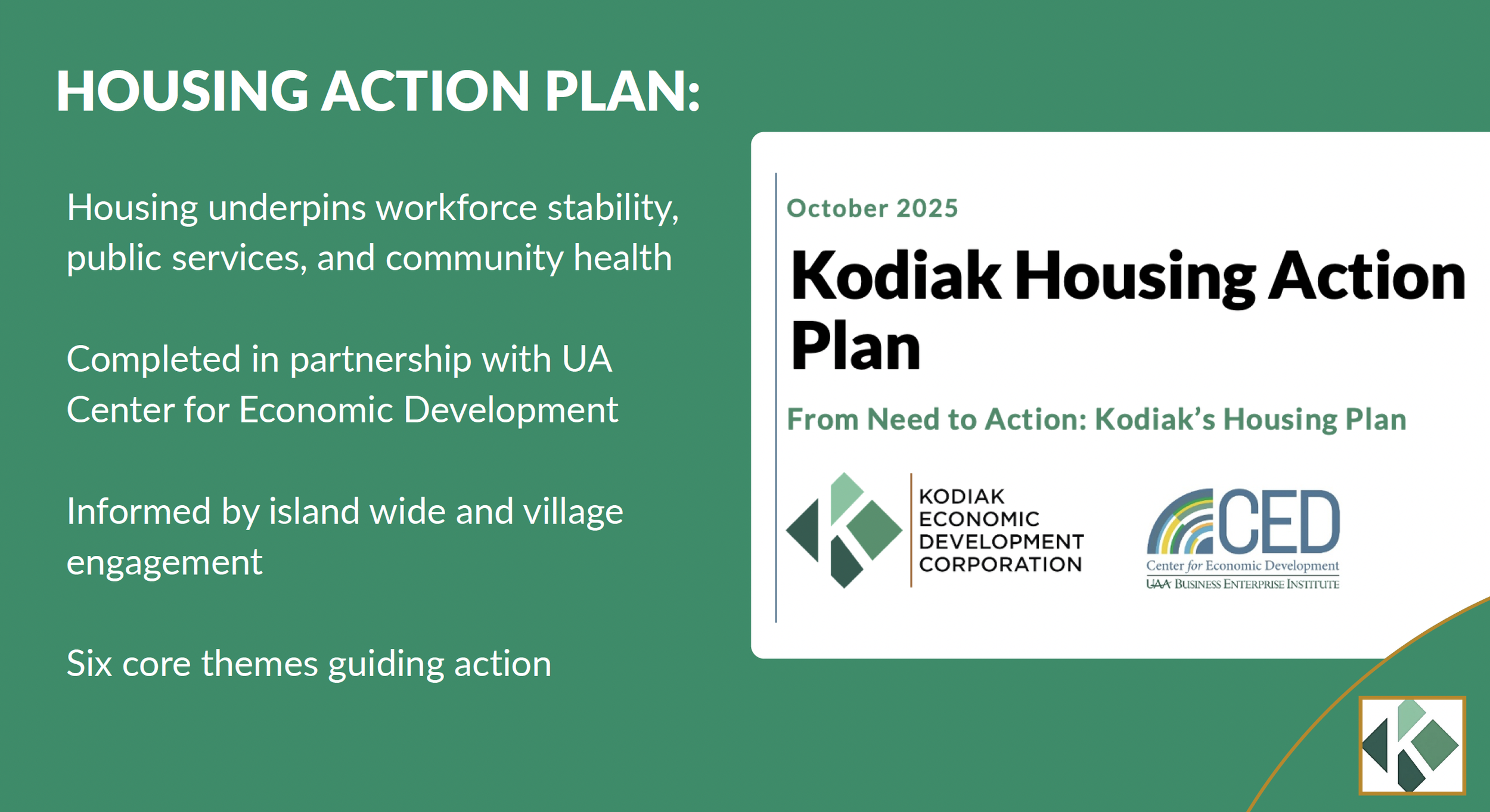
Housing remains one of the most significant challenges facing Kodiak and its surrounding communities. In 2025, KEDC prioritized the completion of the Kodiak Housing Action Plan to provide a shared, data informed roadmap for addressing housing supply, affordability, infrastructure constraints, and long term coordination.
Developed in partnership with the University of Alaska Center for Economic Development, the Housing Action Plan was shaped through extensive public engagement. KEDC conducted village visits, public forums, focus groups, employer outreach, and direct conversations with residents across the archipelago. More than 200 community members participated in this process, ensuring that the plan reflects lived experience as well as technical analysis.
The resulting plan identifies six core themes that together support coordinated action:
Housing finance and revenue tools
Zoning and land use reform
Development process and construction innovation
Infrastructure and the cost of building
Investment in Kodiak village housing
Leadership and coordination
Rather than offering a single solution, the plan emphasizes sequencing, partnership, and realistic near-term actions alongside longer-range goals. It is designed to be a shared reference point for local governments, employers, nonprofits, and community members.
To support transparency and accountability, KEDC launched the Kodiak Housing Dashboard in 2025. The dashboard provides a public, centralized view of housing data, conditions, and implementation progress. It allows residents and decision makers to follow housing work in real time, reduces misinformation, and creates a shared understanding of where progress is being made and where challenges remain.
Housing coordination continued into the fourth quarter of 2025 with the reconvening of the Kodiak Housing Steering Committee. Originally formed during the planning phase, the committee transitioned into a working body focused on implementation and policy development. KEDC reorganized the committee into a three-tier structure that includes core members, advisory members, and community partners, allowing for meaningful participation while maintaining clear roles and accountability.
Early priority areas include short-term rental oversight and compliance, housing funding tools such as voluntary collection agreements, potential dedication of lodging-related revenues to housing, updates to accessory dwelling unit policies with community guardrails, and exploration of a housing coordinator role. Village housing remains a central focus, with continued outreach and coordination with tribal partners.
Building capacity to support housing implementation
Alongside the transition from planning to implementation, KEDC invested in strengthening its capacity to support housing coordination and policy development. This includes working with trusted technical partners to ensure that recommendations are practical, well informed, and responsive to local conditions.
In 2025, KEDC continued its partnership with the to facilitate the Housing Steering Committee and support the development of implementation-focused recommendations grounded in the Kodiak Housing Action Plan. CED’s role includes helping structure work sessions, analyze policy options, and translate plan strategies into clear, actionable pathways that local decision makers can consider.
KEDC also began working closely with the Rural Community Assistance Corporation to build internal housing development knowledge and team-based approaches that strengthen coordination. This training and technical support helps KEDC better serve as a resource to existing housing leaders and organizations, rather than duplicating or replacing their work.
Together, these partnerships support a coordinated approach to housing implementation, combining local leadership with technical expertise. As implementation continues into 2026, KEDC will remain focused on convening partners, tracking progress, and maintaining transparency through regular communication and public tools like the Housing Dashboard.
Supporting economic diversification through mariculture and industry development
Economic diversification remained another key focus in 2025, particularly through mariculture and working waterfront initiatives. KEDC continued to advance engineering, feasibility, and business planning work to support long term industry growth.
A major milestone was progress on the multi-use mariculture processing facility. Engineering work supported by statewide investment moved the project closer to shovel-ready status, with full design completion anticipated in early 2026. This represents a significant step forward from earlier concept-level discussions and positions partners to make informed decisions about future investment and governance.
KEDC also partnered with the CED to complete a business plan and financial model for the facility. This work analyzed product pathways, processing capacity, cost structures, and financial feasibility, providing practical information to guide next steps.
In collaboration with Kodiak Ocean Growers, KEDC and CED advanced an at-sea processing feasibility analysis to explore opportunities for expanded kelp farming in remote locations. This work supports growers by reducing uncertainty and providing data that informs long-term operational planning.
Together, these efforts reflect KEDC’s role in laying groundwork, reducing barriers to entry, and supporting sustainable industry development rather than rushing projects forward without adequate preparation.
Community-driven economic development and Value Chains
Community-driven economic development continued to be a core focus through the Recharge Our Community’s Economy initiative. In partnership with RCAC, KEDC hosted a series of ROCE workshops that brought together residents, businesses, nonprofits, and public partners to identify local economic opportunities grounded in lived experience.
From this work, five community-led Value Chains emerged:
Business Support
Kodiak Walkability
Childcare
Housing
Seafood Market Development
A Value Chain brings people and organizations together around a shared goal and focuses on practical steps that can move ideas into action. These efforts are locally led and build on work already underway across the community.
In 2025, Value Chain participants advanced a range of projects, from business startup resources and downtown walkability improvements to seafood market development and housing coordination. KEDC and RCAC continue to provide facilitation, outreach, and project management support to ensure momentum and follow-through.
Value Chains represent a shift from one-time workshops to ongoing collaboration. They create space for community leadership while maintaining coordination and shared direction.
Strengthening organizational readiness
In December 2025, the KEDC Board of Directors adopted the 2026–2027 Strategic Plan. The plan identifies three primary priorities:
Organizational sustainability and transparency
Housing Action Plan coordination
Career connections and workforce development
Throughout 2025, KEDC strengthened its organizational foundation by improving grant tracking and reporting systems, updating governance documents, maintaining regular communication with public partners, and establishing a permanent office space in downtown Kodiak. The new office provides a place for meetings, trainings, and collaboration and reflects KEDC’s commitment to visibility and accessibility.
Looking ahead to 2026
As KEDC moves into 2026, the focus remains on implementation, coordination, and sustained engagement. Housing policy development, workforce pathways, mariculture readiness, and community-driven economic initiatives all require consistent facilitation across jurisdictions and partners.
Career connections and workforce development will be a growing area of focus. KEDC is working with education, workforce, and employer partners to strengthen career exploration, job shadowing, internships, and mentorship opportunities that help local people build long-term futures in Kodiak.
This work is closely tied to housing and economic diversification. Retaining local talent requires both stable housing and meaningful career opportunities, and KEDC’s role is to help align those efforts rather than treat them separately.
Staying connected and getting involved
Economic development is not a one-time effort or a single plan. It is ongoing work that benefits from broad participation, shared information, and continued collaboration.
We invite community members to:
Sign up for KEDC’s newsletter to stay informed about housing, workforce, and economic development updates. Email us here!
Use the KEDC website as a resource for dashboards, reports, and project information
Participate in existing Value Chains or explore opportunities to help shape new ones
Later this year, KEDC will host a reconvening event to reconnect community members with the Value Chains currently underway, share updates on progress, and explore additional areas where community-led work may be ready to move forward. Details will be shared through the newsletter and website.
KEDC looks forward to continuing to work alongside the Kodiak Island Borough, the City of Kodiak, tribal governments, employers, nonprofits, and residents to support a resilient and inclusive economy for the Kodiak Archipelago.